
Cooling
How much water does a data center use?
Wrong first question. Ask: what kind of data center? Liquid cooling moves heat off the chip. Water consumption depends on how that heat is rejected.
Heat path
GPU
Cold plate
Facility coolant
CDU
Dry cooler
Hot air to atmosphere
This path can reject heat with almost no evaporation
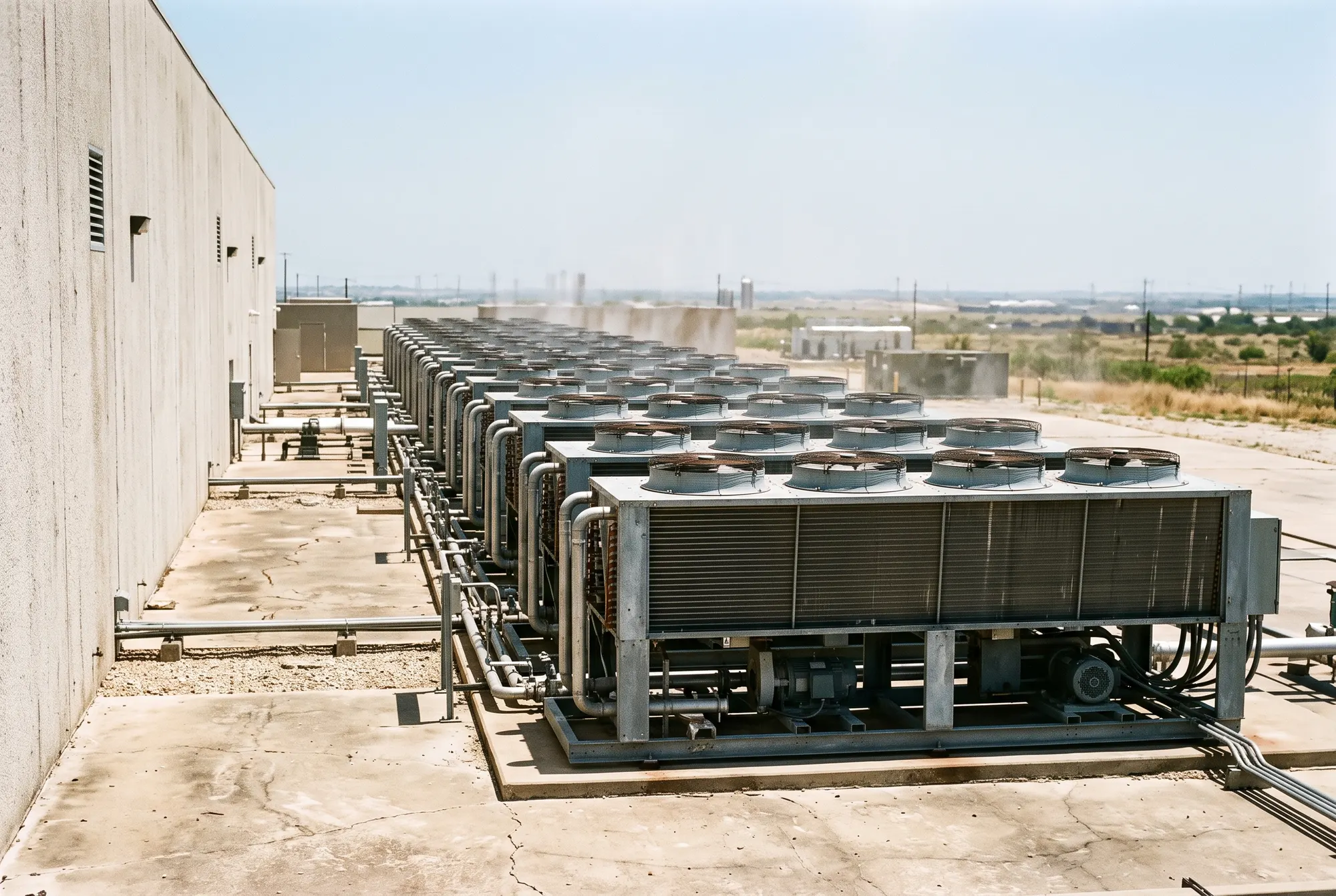
Direct-to-chip liquid + dry cooler
Same cold plates. Heat is rejected with outdoor dry coolers — radiators and fans — instead of evaporating water.
- Where water is consumed
- Very little in a true dry design. A few gallons for loop makeup. Adiabatic spray on extreme days reintroduces water.
- Where it is not
- Liquid-cooled servers do not automatically mean a water-intensive site.
- San Antonio climate
- 110°F afternoons shrink dry-cooler capacity. Many Texas designs add adiabatic assist for peaks, which is a water choice, not a law of physics.
PUE (typical)
Often 1.18–1.50 here. Higher than a tower on the hottest days.
WUE (typical)
Often 0.02–0.25 L/kWh if it stays dry; higher if spray is used.
Then GPUs got hot
Rack density is why liquid showed up.
Traditional enterprise racks often sit near 5–10 kW. Accelerated computing is routinely 30, 60, 100+ kW. Those are not universal — they are why air starts to lose. Coolant at the chip is a density answer. It is still not a water answer.
The two loops
GPU → cold plate → coolant → CDU → facility loop → heat exchanger → outdoors. Then a fork: cooling tower (evaporation, water) versus dry cooler (fans, little water). Mixing those loops is how a city gets the wrong number.
ASHRAE TC 9.9's liquid classes (W17–W45 and high-density H1) are a thermal envelope, not a water meter. Warm-water classes are what make dry, compressor-light rejection possible on many hours of the year. San Antonio's hot-humid afternoons still shrink dry-cooler capacity; adiabatic assist is a water choice, not a law of physics.
Data last checked 2026-09-04 · Current public data is a snapshot, not a live meter
Show me the receipts